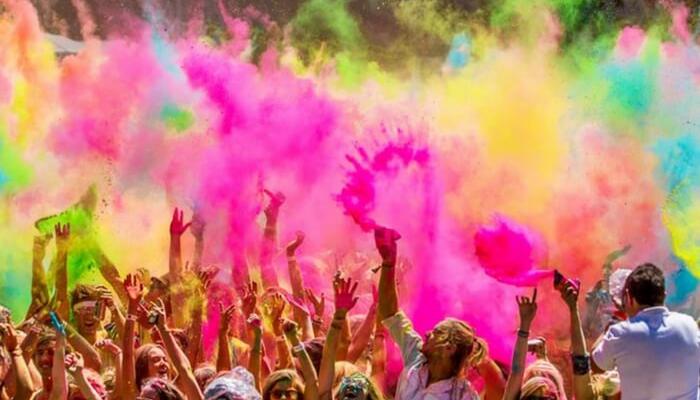
Holi In Rajasthan, The beautiful province of Rajasthan plays Holi similarly to Mathura. A night prior to the full moon, hordes of individuals assemble and light enormous huge fires to consume the leftover dried leaves and twigs of the colder time of year. Individuals toss hued water and powders (gulal and kumkum) at one another and make happy. Singing, moving and the customary beats of dhol add to the mirth of the occasion. On this day even the royals of Rajasthan wear a bubbly soul and blend with the everyday citizens. In fact, illustrious courts all over North India have refined the celebration into the craftsmanship. Rajput fighters of the Rajasthani courts used to flaunt their equestrian abilities during the festival. Even today, Rajput men would ride their horses through the white and pink billows of shading, tossing shading powders on one another. Indeed, even the individuals from the imperial families are not insusceptible from being doused by color. The Braj festival is held out of appreciation for Lord Krishna a couple of days before Holi, in the long stretch of March. The celebration is set apart by verve and zing. Townspeople, in gay, multi-toned clothing, should be visible singing and playing out the Brasilia portraying the interminable romantic tale of Radha and Krishna. The vivid celebration of Holi is played in various ways. The ‘mali’ or grounds-keeper local area of Rajasthan has a one of a kind style where the men shade the ladies with water and ladies fight back by hitting them with sticks or long bits of fabric, Men from 12 towns gather at Godaji town close to Ajmer in Rajasthan to play gair a couple of days later holi. Every town brings its own drummer and gair groups. The beautiful area for it is a valley encircled by slopes on all sides. A great many spectators and near hundred players make a brilliant sight and an affectionate memory. In the Bikaner region, individuals from the ‘Unforgiving’ and ‘Vyas’ people group have been observing Holi by tossing water at each other with power for the past over 300 years. An exceptionally planned vessel called ‘Dolci’ produced using camel skin is utilized for the reason. Yet, the water is tossed distinctly at the rear of a person.
Holi In Rajasthan